At a glance
What it is
A battery-operated pump that delivers medication — usually pain-killers or antispasmodics — directly into the spinal fluid through a small catheter.
Who it helps
Patients with chronic pain, cancer-related pain, or spasticity when oral medications no longer work or their side effects have become too severe.
Where it sits
The reservoir is implanted under the skin of the abdomen or back, and can be refilled from time to time through a small needle through the skin.
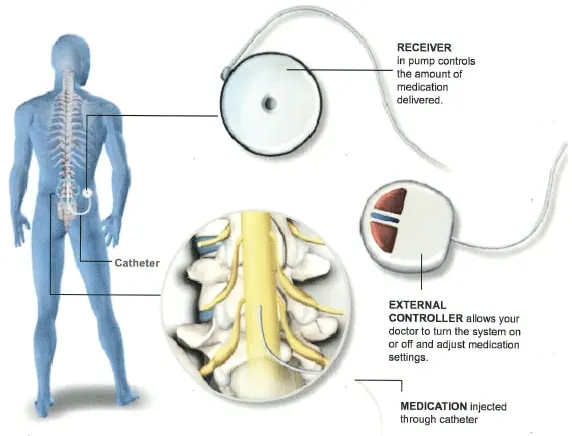
How it works
An intrathecal pump is a battery-operated device which delivers medication directly into the spinal canal. It may be used to treat chronic pain or spasticity, and is sometimes used for cancer-related pain.
The spinal canal contains a large amount of fluid — cerebrospinal fluid, or CSF — in which the nerves bathe. By inserting a small catheter connected to a programmable reservoir, medications such as pain-killers can be delivered directly to these nerves.
The reservoir (or chamber) is implanted under the skin of the abdomen or back, and can be refilled from time to time by inserting a small needle through the skin.
Which conditions can be treated
An intrathecal pump is considered for a defined set of conditions:
- **Chronic pain conditions** - Complex regional pain syndrome (neuropathic pain) - Multiple sclerosis pain - Failed back surgery pain - **Cancer-related pain** - **Spasticity** - Cerebral palsy - Brain injury
When surgery is considered
When medications and other treatments are no longer working well, or when their side effects have become too severe, surgery to implant a pump may be of value.
A number of medications are useful for pain before this point is reached: standard opioid and non-opioid analgesics, anti-inflammatory medications, membrane-stabilising agents and anticonvulsants, as well as pregabalin. Special medical treatments such as ketamine infusions, local nerve and joint blocks, and other surgical options such as spinal cord stimulation should also be considered before moving to a pump.
Aims and potential benefits
The goals of intrathecal medication delivery are:
- Effective pain relief - Decreased spasticity - Reduced medication requirements and fewer systemic side effects (such as drowsiness) - Improved quality of life
The chance of obtaining a significant benefit depends on a wide variety of factors. Your neurosurgeon will give you an indication of the likelihood of success in your specific case.
If treatment is not undertaken, the likely outcomes are ongoing pain or spasticity and a reduced quality of life.
How the procedure is performed
An intrathecal pump is inserted through a simple and safe surgical procedure. A small incision is made in the back, and a flexible catheter is introduced into the spinal canal. This is then connected to a battery-operated pump placed under the skin of the abdomen.
Complications are uncommon, and may include bleeding and infection. The patient is discharged on either the same day or the day after surgery.
Need more information?
Reach out to our team for more details about the topics covered in this article.
This article provides general information and is not a substitute for professional medical advice. If you have specific health concerns, please consult with a healthcare provider.