At a glance
What it is
A minimally invasive procedure that uses radiofrequency current to heat targeted nerves and switch off pain signals travelling from arthritic or facet joints to the brain.
Who it helps
Patients with chronic low-back and neck pain, and joint pain from arthritis, who have not responded well to conservative care or steroid injections.
Setting
Outpatient day-case. Local anaesthetic and light sedation — no open surgery, no general anaesthesia. Someone drives you home the same day.
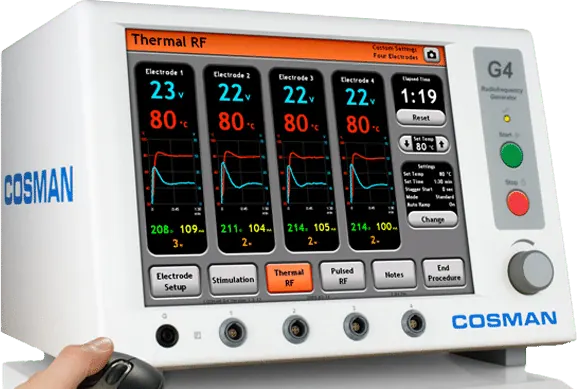
How radiofrequency neurotomy works
Radiofrequency neurotomy — also called radiofrequency ablation or lesioning — is a minimally invasive procedure that can give lasting relief to patients with facet joint pain. Multiple clinical studies show that it significantly reduces the severity and frequency of pain for one to two years in the majority of patients.
The procedure applies heat to specific nerve pathways to "shut off" the transmission of pain signals to the brain. It is done on an outpatient basis and needs only local anaesthetic and mild sedation, avoiding the complications of open surgery and general anaesthesia. It has a high success rate and a low complication rate.
Which conditions we treat with RFA
RFA is used for patients with chronic (long-lasting) low-back and neck pain, and for pain from degeneration of joints in arthritis. In practice this covers:
- Chronic low back pain from facet joint arthritis - Chronic neck pain from cervical facet joints - Knee osteoarthritis pain, via genicular nerve ablation - Spinal pain that has not responded to conservative care or steroid injections
Thermal vs pulsed radiofrequency
There are two types of radiofrequency ablation. The choice depends on the nerve being targeted and the goal of treatment.
TYPE A
Thermal radiofrequency
- Tissue temperature reaches up to 80°C
- Creates a heat lesion that interrupts the nerve
- Used for facet joint denervation and other sensory nerves
- Longer-lasting pain relief
TYPE B
Pulsed radiofrequency
- Tissue temperature stays at or below 45°C
- Modulates the nerve without destroying it
- Preferred near mixed motor-sensory nerves
- Lower risk of numbness or deafferentation
What the outcomes look like
The degree of pain relief depends on the cause and location of the pain.
1–2 yrs
typical duration of relief
>70%
of patients experience pain relief after RFA
6 mo–2 yrs+
relief range; in some cases lasts for years
Key facts

Is RFA safe? Who should not have it
RFA has proven to be a safe and effective way to treat certain forms of pain. It is generally well tolerated, with very few associated complications. There is a slight risk of infection and bleeding at the insertion site; your doctor will advise on your particular risk.
As with any medical procedure, RFA is not appropriate for everyone. It is not recommended for people who have active infections or bleeding disorders. Your doctor can confirm whether RFA is right for you.
How to prepare for the procedure
A few precautions the day of the procedure:
- Do not eat within six hours of your appointment; clear liquids are allowed up to two hours before. - If you have diabetes and use insulin, adjust your insulin dose the day of the procedure — your primary-care doctor will help with the adjustment. Bring your diabetes medication with you to take after the procedure. - Continue all other medications with a small sip of water. Bring them with you so you can take them after the procedure. Do not stop any medication without first consulting your primary or referring doctor. - Arrange someone to drive you home afterwards. Do not drive or operate machinery for at least 24 hours after the procedure.
What happens during the procedure
You will first meet the doctor for an evaluation. If RFA is recommended, the doctor will explain the procedure in detail — including possible complications and side effects — and answer any questions you have.
An intravenous (IV) line may be placed in your arm, and local anaesthetic with mild sedation is used to keep you comfortable. You may stay awake during the procedure to help assess nerve targeting.
After the local anaesthetic (you will be awake but pain-free), the doctor inserts a small needle into the area of your pain. Using X-ray or ultrasound guidance, the needle is directed to the exact target. A microelectrode is then passed through the needle to begin the stimulation phase — you will be asked whether you feel a tingling sensation, which helps confirm the electrode is in the optimal spot.
Once needle and electrode placement are verified, a small radiofrequency current is passed through the electrode into the surrounding tissue, heating it to the treatment temperature. You should not feel discomfort during the heating phase.
After the procedure and going home
Immediately after RFA:
- You stay in a recovery room for observation while a nurse checks your blood pressure and pulse. - A dressing is placed over the injection site. - The nurse offers you a drink and reviews your discharge instructions. - Someone must drive you home.
For the first day or two:
- Do not drive or operate machinery for at least 24 hours. - You may resume your normal diet straight away. - Avoid strenuous activity for the first 24 hours. - No bath for one to two days — showering is fine. - You can remove any dressings the evening after the procedure.
Side effects and warning signs
You may notice the following after RFA:
- **Leg numbness.** If your leg feels numb, walk only with assistance. This should last only a few hours and is due to the local anaesthetic. - **Mild back discomfort.** This may appear as the local anaesthetic wears off and usually lasts two or three days. Apply ice to the area on the day of the procedure and moist heat the following day if discomfort persists. Your usual pain medications can be used.
**When to call us.** If you feel severe pain at the injection site, notice swelling or redness, or develop increased leg weakness, contact your doctor — you need to be evaluated for bleeding or injection-related complications.
Need more information?
Reach out to our team for more details about the topics covered in this article.
This article provides general information and is not a substitute for professional medical advice. If you have specific health concerns, please consult with a healthcare provider.