At a glance
What it is
The most common cause of dementia. A progressive neurological disorder in which brain cells die and the brain shrinks, leading to relentless cognitive and functional decline. Affects an estimated 60–70% of all dementia cases worldwide.
Symptoms
Memory loss (especially recent events), difficulty organising thoughts, language problems, disorientation, mood and behaviour changes, and loss of the ability to carry out daily tasks — worsening over years.
Approach
No cure. Cholinesterase inhibitors and memantine temporarily slow cognitive decline. rTMS combined with cognitive training shows evidence of improving cognitive scores. Ongoing support and care planning are essential.
What Alzheimer's disease is
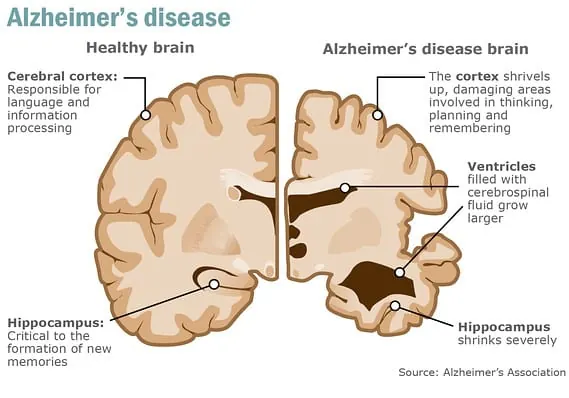
Alzheimer's disease is a progressive neurological disorder in which abnormal protein deposits — amyloid plaques and neurofibrillary tau tangles — accumulate in the brain, disrupting neuronal communication and eventually killing brain cells. As neurons die, the brain physically shrinks (atrophies), particularly in the hippocampus and cortex — regions critical for memory and thinking.
It is the most common cause of dementia, accounting for an estimated 60–70% of all dementia cases worldwide. The disease most commonly affects people over 65, though early-onset Alzheimer's can occur in people in their 40s and 50s.
**Symptoms progress in stages:** - **Early stage:** Forgetting recent conversations or events, misplacing items, difficulty recalling names and words, mild disorientation - **Middle stage:** Worsening memory, difficulty recognising family members, confusion about time and place, personality and behaviour changes (agitation, depression, suspicion), problems with daily tasks - **Late stage:** Severe memory loss, inability to communicate verbally, complete dependence on caregivers, difficulty swallowing, vulnerability to infections
**No treatment cures or reverses Alzheimer's disease.** In advanced stages, complications from severe loss of brain function — dehydration, malnutrition, or infection — are the usual cause of death.
**Current treatments:** - **Cholinesterase inhibitors** (donepezil, galantamine, rivastigmine) — preserve the neurotransmitter acetylcholine to temporarily improve communication between neurons; modest but consistent cognitive benefit; may also reduce agitation and depression - **Memantine** (Namenda) — acts on a separate glutamate communication network; used in moderate-to-severe Alzheimer's, sometimes with a cholinesterase inhibitor - **rTMS combined with cognitive training** — clinical studies in Alzheimer's patients show that daily rTMS sessions over the relevant cortical and hippocampal networks, combined with structured cognitive training, produce significant improvement in Alzheimer's Disease Assessment Scale (ADAS-Cog) scores after 6 weeks, with benefits maintained with ongoing maintenance sessions. rTMS is thought to enhance synaptic plasticity and increase brain-derived neurotrophic factor (BDNF) — processes that are impaired in Alzheimer's disease.
Treatment options at Alimran Medical Center
Neuromodulation
Advanced therapies
Physiotherapy
- Electrical stimulation
- Laser therapy
- Cognitive and functional exercises
Book a consultation
The secretary schedules first appointments during clinic hours; please have prior imaging, operative notes and a current medication list available at the time of the call.
This page provides general information about alzheimer's disease and is not a substitute for individual medical assessment. If your symptoms are severe or worsening, contact a clinician promptly.