At a glance
What is a stroke?
A medical emergency caused by a problem with blood supply to the brain. Immediate treatment is essential — early intervention can limit brain damage and complications.
Two main types
Ischemic stroke (the most common) — too little blood reaching the brain. Hemorrhagic stroke — excess blood inside the skull from a ruptured vessel.
Why rehabilitation matters
Stroke often leaves temporary or permanent disabilities. A structured rehabilitation programme aims to return the affected part to function and reduce dependence on others.
Overview
A stroke is a medical emergency. Immediate treatment is absolutely essential — early intervention can reduce brain damage and its complications.
The good news: strokes can be both treated and prevented.
Symptoms
If you think that you or someone else is having a stroke, watch for the signs and symptoms below. Note the time the symptoms begin — the duration affects which treatment options are available:
- **Trouble speaking or understanding speech.** You may become confused, speak unclearly, or have difficulty understanding what others say. - **Sudden numbness, weakness, or paralysis of the face, arm, or leg.** This typically affects one side of the body. Try to raise both arms above your head at the same time — if one arm drifts down, you may be having a stroke. One side of the mouth may also droop when you try to smile. - **Vision problems in one or both eyes.** Sudden blurred or blackened vision, or double vision. - **Headache.** A sudden, severe headache — sometimes with vomiting, dizziness, or a change in consciousness — can signal a stroke. - **Trouble walking.** You may stumble or feel suddenly dizzy, and lose balance or coordination.
The two types of stroke
A stroke happens when something disrupts the blood supply to the brain. Which type it is determines the emergency treatment.
MOST COMMON
Ischemic stroke
- Too little blood reaching the brain
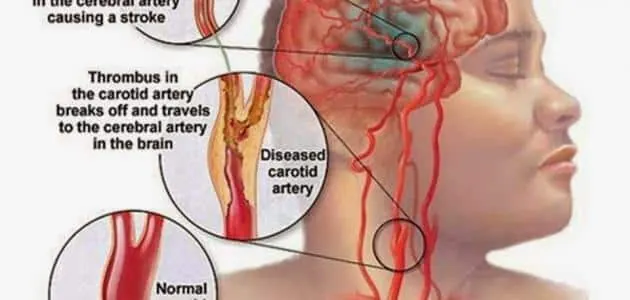
- Caused by a blockage (clot) in an artery
- May be treated with blood thinners under the right conditions
- Surgical clot removal is considered when the blockage exceeds 70%
LESS COMMON
Hemorrhagic stroke
- Excess blood inside the skull
- Caused by rupture of a blood-vessel wall
- Linked to high blood pressure and weakened vessels
- Focus is on controlling bleeding and intracranial pressure
Causes
There are many causes of a stroke, including:
- Cerebral bleeding from a ruptured vessel wall, often driven by high blood pressure and vessel-wall weakness - Heart disease and cardiac disorders - Psychological stress such as fear and anxiety - Poor blood circulation - Drug use, particularly cocaine - Obesity and weight gain - High levels of bad cholesterol in the blood - Hypertension and advancing age - Persistent headache - Muscle wasting - Blurred vision - Progressive hearing loss - Impaired movement and balance - Heredity
Risk factors
Many factors increase the risk of stroke, and some also raise the risk of a heart attack. Treatable risk factors fall into two groups.
**Lifestyle factors**
- Overweight or obesity - Physical inactivity - Heavy drinking - Use of illicit drugs such as cocaine or methamphetamine
**Medical factors**
- Blood pressure readings above 120/80 mmHg - Smoking or exposure to second-hand smoke - High cholesterol - Diabetes - Obstructive sleep apnoea - Cardiovascular disease — including heart failure, cardiac infection, and abnormal heart rhythm - Family history of stroke, heart attack, or transient ischaemic attack
Other factors that raise the risk of stroke:
- **Age.** People 55 and older are at higher risk than younger adults. - **Race.** African-Americans have a higher risk than other groups. - **Sex.** Men are at greater risk than women — though women tend to be older when they have a stroke and are more likely to die from one. - **Hormones.** Contraceptive pills or hormone therapy containing oestrogen, and the raised oestrogen levels of pregnancy and childbirth.
Complications
A stroke can cause temporary or permanent disability, depending on how long the brain was starved of blood and which part was affected. Complications may include:
- **Paralysis or loss of muscle movement.** You may be paralysed on one side of the body, or lose control of specific muscles such as those on one side of the face or in one arm. Physical therapy helps recover activities affected by paralysis — walking, eating, dressing. - **Difficulty speaking or swallowing.** A stroke can weaken control of the mouth and throat muscles, causing slurred speech (dysarthria), or difficulty swallowing and eating (dysphagia). There may also be language difficulty (aphasia) — trouble speaking, understanding speech, reading, or writing. - **Memory loss and thinking difficulties.** Many stroke survivors experience some memory loss. Others develop difficulty thinking, making judgements, reasoning, or understanding concepts. - **Emotional problems.** Controlling emotions can become harder, and depression is common. - **Pain.** Some people feel pain, numbness, or unusual sensations in body parts affected by the stroke. For example, if the stroke caused loss of sensation in the left arm, that arm may feel an uncomfortable tingling.
Patients may also become very sensitive to changes in temperature — especially extreme cold — after a stroke. This is known as central post-stroke pain or central pain syndrome. It usually develops several weeks after the stroke and may improve over time. Because the pain originates in the brain rather than a physical injury, treatment options are limited.
- **Changes in behaviour and self-care.** Stroke survivors may become more withdrawn and less sociable, or more impulsive. They may need help caring for themselves and performing daily tasks.
As with any brain injury, the success of treatment varies from person to person.
Prevention
Being aware of the risk factors and following a healthy lifestyle are the right steps to prevent a stroke.
A healthy lifestyle includes:
- Treating hypertension (high blood pressure) - Reducing foods high in cholesterol and fats - Avoiding smoking - Managing diabetes - Maintaining a healthy weight - Exercising regularly - Managing psychological stress - Avoiding alcohol - Avoiding drugs - Keeping to a balanced, healthy diet
Emergency treatment
Emergency treatment depends on whether it is an ischemic stroke — a blocked artery, the most common type — or a hemorrhagic stroke involving bleeding in the brain.
In general, treatment proceeds as follows:
1. **Emergency care** — hospital admission and stabilisation. 2. **Medication after the patient stabilises**, which includes: - Treating blood pressure and diabetes - Managing intracranial pressure - Anti-clotting therapy (blood thinners) for ischemic stroke, when the necessary conditions are met - Surgical intervention for arterial blockage by thrombus — when the blockage exceeds 70% this reduces severity and mortality, with a complication rate below 6% 3. **Physical therapy and rehabilitation** — the focus of the sections that follow.
Rehabilitation goals
Post-stroke rehabilitation has two clear goals:
1. Return the affected part to its function. 2. Reduce dependence on others.
The programme is multidisciplinary — rehabilitation, physiotherapy, adaptive training, mental, social, functional, and speech therapy.
The rehabilitation programme
Post-stroke recovery at the centre is organised into four lines of treatment, chosen and combined for each patient.
1. Conventional (mechanical) therapy
The foundation of every programme
- Teaching the correct posture for sitting and lying down
- Joint work on the affected side
- Stretching, strengthening, and resistance exercises
2. Physical therapy
Stimulating the nerve and muscle in the affected area
- Different types of electrical stimulation — FES, IDC, IF, TENS — chosen by case and condition
- Cold laser therapy, long-wave, ultrasound, SAD
- Running and walking exercises (slow and fast)
- Biofeedback devices — using cues sent to the brain, or mirror work, to make the patient more aware of the affected limb and improve its movement
3. Advanced devices (third line)
For patients who need more than conventional physiotherapy
- Non-invasive brain stimulation (rTMS)
- Non-surgical epidural stimulation of the spinal cord
- SPINMED — mechanical spinal traction for slipped disc, nerve compression, and lower-limb pain
- Virtual reality software and games that help move the affected part
4. Managing stroke complications
The secondary problems that often follow
- Shoulder dislocation
- Tendon inflammation and rupture
- Fluid accumulation and swelling
- Muscle and tendon spasticity — treated with local injections (BOTOX) or acupuncture needles
- Bladder weakness and loss of control
- Loss of speech, or difficulty finding words
- Post-stroke depression
The specific combination is chosen per patient, based on which part of the brain was affected and how long ago the stroke occurred.
Need more information?
Reach out to our team for more details about the topics covered in this article.
This article provides general information and is not a substitute for professional medical advice. If you have specific health concerns, please consult with a healthcare provider.