At a glance
What it is
A rare hormonal disorder in which the pituitary gland overproduces growth hormone — most commonly due to a benign pituitary adenoma. Causes progressive bone and soft tissue enlargement, typically in middle-aged adults.
Symptoms
Enlarged hands and feet, coarsened facial features (protruding jaw, enlarged nose and lips), joint pain, headaches, vision loss, thickened skin, excessive sweating, and in advanced cases cardiac enlargement and spinal cord compression.
Approach
Primary treatment targets the tumour: surgery, somatostatin analogues, dopamine agonists, or radiosurgery. Physiotherapy and pain management support joint pain, muscle weakness, and recovery from complications.
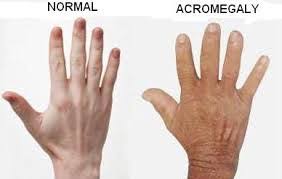
What acromegaly is
Acromegaly is a hormonal disorder caused by excess growth hormone (GH) secretion from the pituitary gland over a prolonged period. More than 95% of cases are caused by a benign pituitary adenoma — a non-cancerous tumour that secretes GH continuously. The excess GH drives the liver to produce insulin-like growth factor 1 (IGF-1), which stimulates growth in bones and soft tissue throughout the body.
Because the condition develops gradually, signs often go unnoticed for years and are frequently identified only by comparing old photographs with current appearance.
**Common symptoms include:** - Enlarged hands and feet — rings no longer fit, shoe size increases gradually - Coarsening of facial features: protruding jaw and brow ridges, enlarged nose, thickened lips, widened tooth gaps - Thick, oily, coarse skin; skin tags - Excessive sweating and body odour - Deep, husky voice (enlarged vocal cords and sinuses) - Loud snoring (upper airway obstruction) - Joint pain and limited range of motion - Headaches and visual disturbances (from tumour pressure) - Enlarged tongue - Fatigue and muscle weakness - Irregular menstrual cycles in women; erectile dysfunction in men - Enlarged heart and other organs - Reduced libido
**Complications** if untreated include hypertension, cardiomyopathy, osteoarthritis, diabetes mellitus, thyroid enlargement, colonic polyps, sleep apnoea, carpal tunnel syndrome, spinal cord compression, and vision loss. Untreated acromegaly can lead to premature death.
**Treatment** targets reducing GH production and shrinking the tumour:
- **Surgery** — endoscopic transnasal transsphenoidal surgery removes the pituitary adenoma through the nose. Normalises GH in most cases; some patients need additional treatment if the tumour cannot be fully removed. - **Somatostatin analogues** (octreotide, lanreotide) — monthly injections that suppress GH secretion. - **Dopamine agonists** (cabergoline, bromocriptine) — oral medications that lower GH and IGF-1 and may shrink the tumour. - **GH receptor antagonist** (pegvisomant) — daily injection that blocks GH action on tissues; normalises IGF-1 without reducing GH or tumour size. - **Radiosurgery** — used when tumour cells remain after surgery; slowly reduces GH over years.
Treatment options at Alimran Medical Center
Injection therapies
- Trigger point injections
- Epidural steroid injections
- Ozone injection
- Prolotherapy
Advanced therapies
Physiotherapy & rehabilitation
- Electrical stimulation
- Short and long wave therapy
- Laser therapy
- Ultrasound therapy
- Muscle strengthening and joint mobility exercises
- SpineMED® system
- Sigma
Book a consultation
The secretary schedules first appointments during clinic hours; please have prior imaging, operative notes and a current medication list available at the time of the call.
This page provides general information about acromegaly and is not a substitute for individual medical assessment. If your symptoms are severe or worsening, contact a clinician promptly.